
Revelation
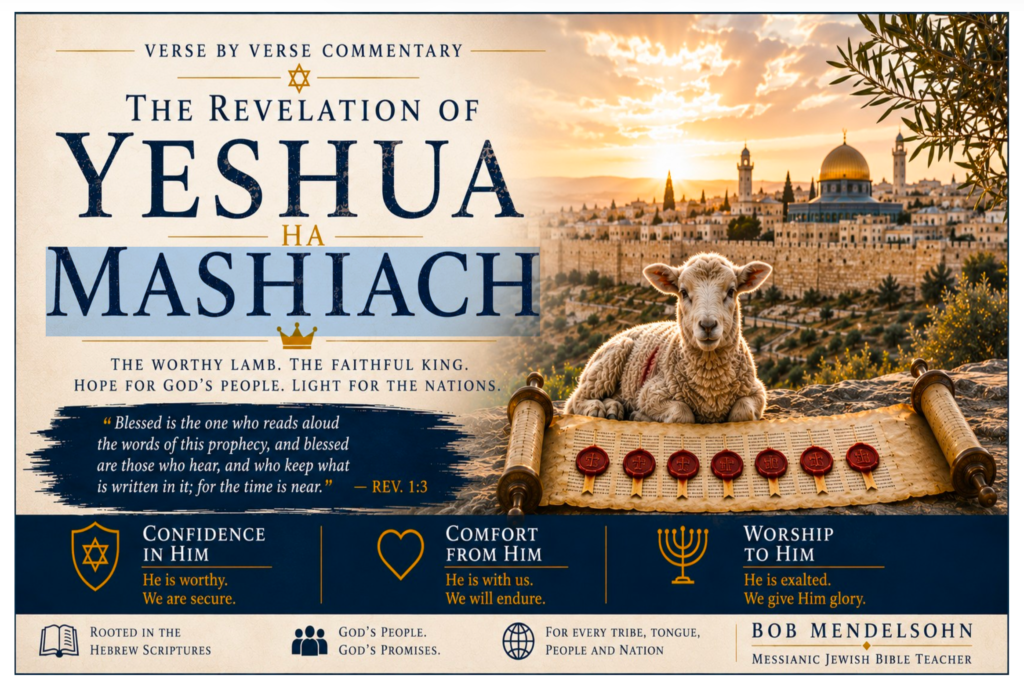
Few books of the Bible have generated as much fascination, speculation, confusion, and sometimes fear as Revelation. Its pages are filled with extraordinary images—lampstands and stars, beasts and battles, judgment and worship, heaven and earth. It has inspired countless sermons, charts, predictions, novels, films and predictions about what will happen next. But before we try to decode Revelation, we need to remember what kind of book we are reading, what its purpose is and, more importantly, whom the book is revealing.
Follow this commentary week by week until all 22 chapters are complete. And see what you can learn for your life in the 21st century wherever you live. We have posted Chapters 1-15 so far. Keep coming back for more.
Introduction — How Should We Read Revelation?
Before beginning the 22 chapters, read this overview of how Revelation should be understood—its first-century setting, its use of the Tanakh, and its two great purposes: comfort and worship.
Chapter One: Write It Down!
John sees the risen Yeshua, who holds the keys and says, “Do not be afraid.”
Chapter Two: Letters to the Churches (Part 1)
Yeshua speaks to four churches, calling His people to faithfulness.
Chapter Three: What's in a Name?
Three churches discover that Yeshua’s assessment matters more than reputation.
Chapter Four: No Place Like Home
Through an open door in heaven John sees the throne of God, surrounded by worship, glory and hope.
John hears of the conquering Lion but sees the slain Lamb—Yeshua, the only One worthy to open the scroll and receive the worship of all creation.
The Lamb opens the seals and the world begins to shake. Yet amid conquest, war, famine and death, one truth remains: God is still on the throne.
John sees a great multitude from every nation. God seals them as His own, and brings them through tribulation into worship.
Heaven falls silent. John draws on the Exodus and prophets to show that judgment is real but limited. God still hears, and calls His people to endurance.
John sees terrifying images of destruction, torment and death. The greater tragedy comes at the end: people still refuse to repent. What does the wise sinner do?
Who are the two witnesses? Can any good come from their death? Apparent defeat is never the end of the story. The great announcement: the kingdom belongs to God and His Messiah.
Who is the woman and why is there such a battle with her and the Dragon? And how could believers then…and today… overcome the painful trials of the day? The threefold answer still works.
Who is the beast, and what does 666 mean? What role does worship play in the last days?
The Triumph of Yeshua is manifest, no matter how much blood surrounds the land, or how resistent Babylon continues to be.
Songs of Moses in Exodus and Deuteronomy remind us of the Song here. Miriam leads the women there, the multitudes (including the nations) sing here to the Triumphant One.